
Food Eco-Culture Edu - final logo
Co Funded By The EU
This project has been funded with support from the European Commission. The author is solely responsible for this publication (communication) and the Commission accepts no responsibility for any use may be made of the information contained therein. In compliance of the new GDPR framework, please note that the Partnership will only process your personal data in the sole interest and purpose of the project and without any prejudice to your rights.

The Food Eco-Culture Edu Curriculum & Modules

This curriculum is the result of extensive interdisciplinary research and collaborative development by a dedicated team of Higher Education Institutions (HEIs) and pedagogical experts. The Food Eco-Culture Education (FECE) curriculum and its modules are designed to directly address critical challenges such as skills shortages and sustainability pressures in the food, hospitality, and tourism sectors.


Abstract geometric ShapeAbstract geometric Shape
Abstract geometric Shape
A teacher assists students at a desk, focusing on a laptop, while notebooks and stationery are spread around in a classroom setting.
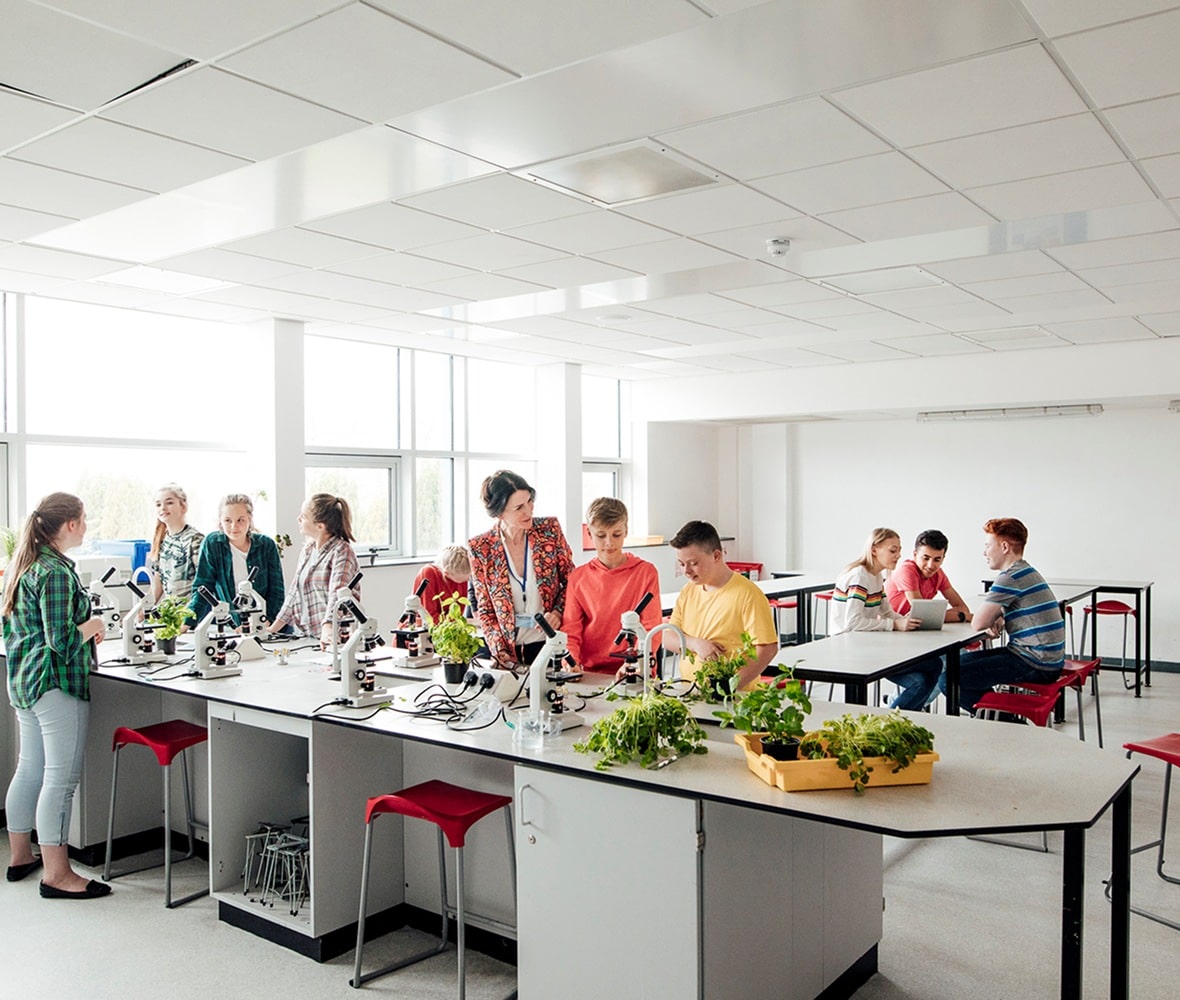
A bright laboratory with students engaged in a plant science activity, using microscopes and surrounded by greenery on their tables.

A Research-Driven Educational Model

Learners can be confident that every topic within this curriculum was selected based on significant evidence-based research. The design process involved:
Interdisciplinary Research: Insights from environmental, cultural, and social studies to ensure a holistic view of modern food systems.
Stakeholder Validation: Participatory workshops held across six partner institutions with students and local industry stakeholders to identify real-world skills gaps and future-oriented needs.
Expert Design: A structured, modular framework crafted by academic and pedagogic leaders to be adaptable across diverse European educational and professional contexts.

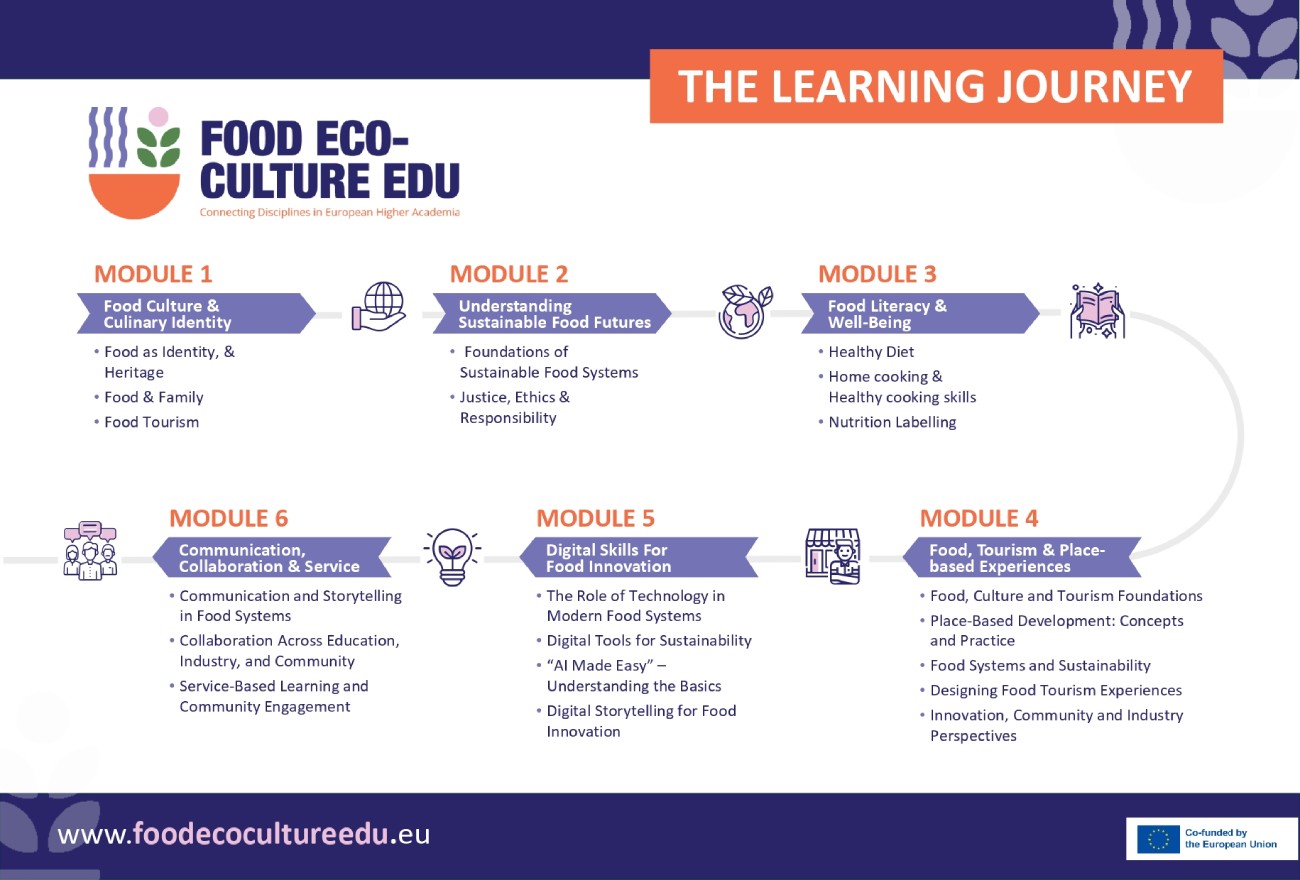
The 6 Food Eco-Culture Edu Modules

The curriculum is articulated through six interdisciplinary modules, each designed to equip students with practical, future-ready competencies:

Module 1: Culinary Traditions & Cultural Identity

Explores food as a social and identity-forming practice, analysing its connection to heritage, family, and tourism.

Module 2: Understanding Sustainable Food Choices

Introduces circular economy principles, ethical supply chains, and practical ways to reduce environmental impact.

Module 3: Food Literacy & Wellbeing

Focuses on how everyday food choices and cooking skills influence personal health and social outcomes.

Module 4: Food, Tourism, & Place-based Experiences

Teaches how to design sustainable tourism experiences that respect local culinary resources and community identity.

Module 5: Digital Skills for Food Innovation

Covers the digital transformation of the food sector, including smart systems and AI applications for sustainability.

Module 6: Communication, Collaboration, & Service

Emphasises co-creating knowledge through community engagement and service-based learning to support inclusive food systems.

Transformative Learning for Future Leaders

This curriculum focuses on creating a transformative learning experience by integrating these interdisciplinary modules into food and hospitality education. Designed to equip students with the skills and knowledge to lead in the evolving food sector, the curriculum explores themes like sustainability, nutrition, cultural identity, and food innovation. It combines research, real-world feedback from industry experts, and  pilot studies to create a robust, inclusive, and sustainable educational model.

The curriculum aims to reshape higher education by ensuring that students are prepared to tackle contemporary food sector challenges with interdisciplinary and practical solutions.


Abstract geometric Shape
menu